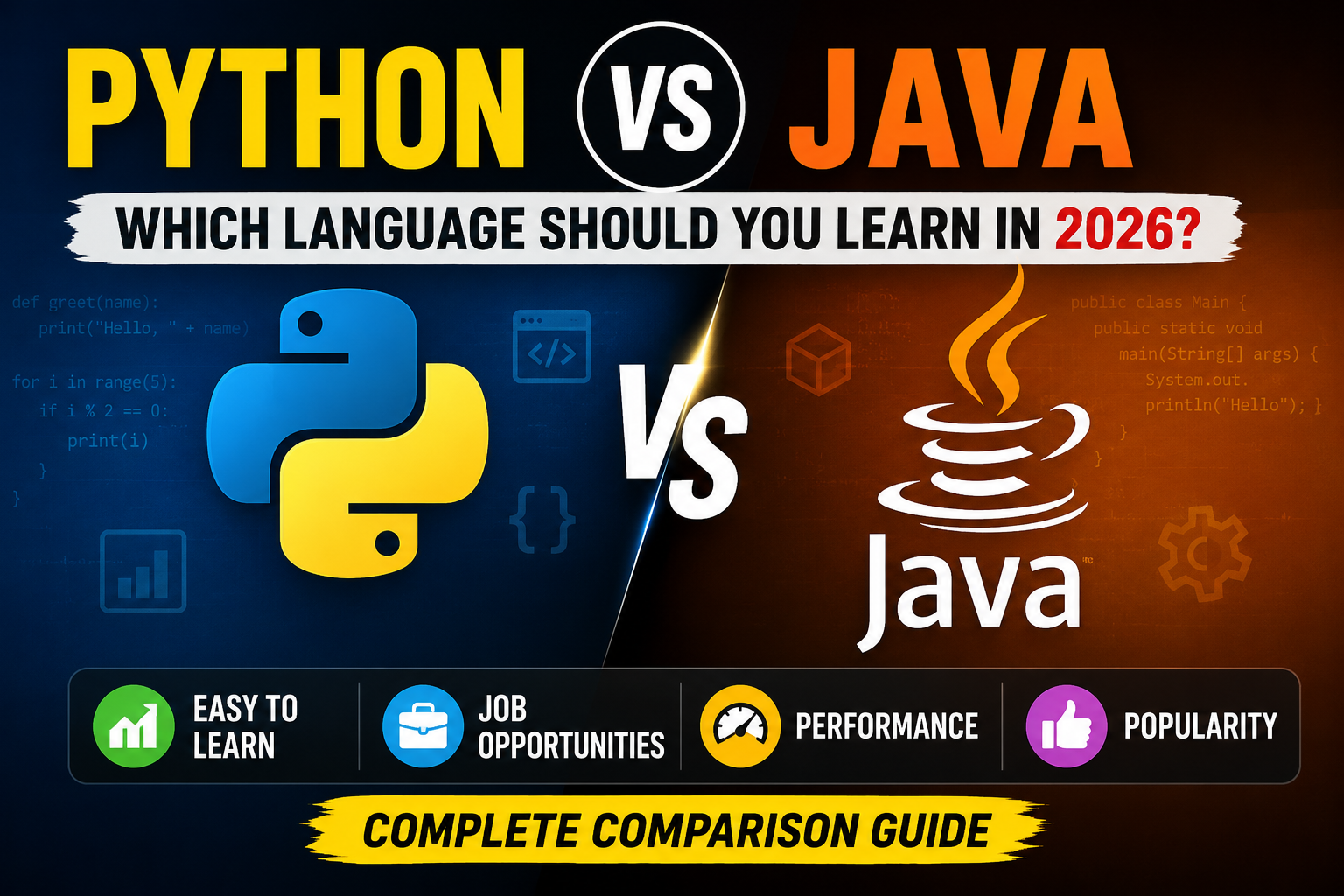
What Is Python vs Java?
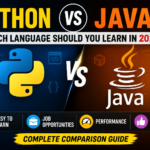
Python is a high-level, interpreted programming language. Created by Guido van Rossum in 1991, its core philosophy is simple: readability counts. It relies on clean design and uses English-like words instead of complex symbols, making it feel less like programming and more like writing a logical script.
Java is a high-level, class-based, object-oriented programming language released by Sun Microsystems in 1995 (now owned by Oracle). Java operates on a core promise: “Write Once, Run Anywhere” (WORA). It compiles code into bytecode, which runs inside a virtual machine. This means it doesn’t matter if your company’s servers run on Linux, Windows, or specialized cloud architecture—Java runs identically across all of them.
Why People Use These Languages
Developers lean toward Python when they want to solve problems quickly without wrestling with the rules of the language itself. If a data analyst needs to clean a messy spreadsheet containing millions of rows, Python lets them write a ten-line script to do it in a single afternoon.
Conversely, systems engineers use Java when failure is not an option. Consider a major banking application handling thousands of credit card transactions per second. A minor memory leak or an unhandled data type error could crash the system and cause millions of dollars in damages. Java’s strict structure prevents these mistakes before the application ever goes live.
Key Features
Python Features
- Dynamically Typed: You don’t need to declare what kind of data a variable holds. A variable can hold a number now and a piece of text later.
- Interpreted Execution: Code is executed line by line, which makes debugging incredibly fast.
- Massive Library Ecosystem: If you need to build something, someone has likely already written a library for it (e.g., NumPy for math, Pandas for data).
Java Features
- Statically Typed: Every single variable must have an explicitly declared type (like integer, string, or boolean). The system checks this before running.
- Multithreading: Java handles complex, parallel tasks within a single program exceptionally well.
- The Java Virtual Machine (JVM): The JVM provides an isolated environment that optimizes performance on the fly using Just-In-Time (JIT) compilation.
How It Works
The fundamental difference between these two languages lies in how your computer reads your commands.
Python Approach:
[Your Code] ---> [Python Interpreter reads line-by-line] ---> [Machine Action]

Java Approach:
[Your Code] ---> [Java Compiler checks for errors] ---> [Bytecode] ---> [JVM executes on hardware]
Let’s look at a classic example: printing a simple “Hello, World!” message to the screen.
The Python Way
Python
print("Hello, World!")
The Java Way
Java
public class HelloWorld {
    public static void main(String[] args) {
        System.out.println("Hello, World!");
    }
}
A beginner looking at the Java code might instantly feel overwhelmed by words like public, static, void, and String[] args. In Python, the intent is immediately obvious.
A Realistic Scenario: A student trying to build a simple budget tracker over the weekend will likely finish the project using Python. If they used Java, they might spend the first day just figuring out how to configure the compiler, project structure, and class paths.
Practical Use Cases
Where Python Excels
- AI and Machine Learning: Frameworks like PyTorch and TensorFlow make Python the default language for training neural networks.
- Data Analysis: Scientists and financial analysts use Python to process complex statistical models.
- Web Scraping: Extracting data from thousands of web pages automatically.
Where Java Excels
- Enterprise Software: The backend engines behind massive corporations, airlines, and insurance databases.
- Android Mobile Development: Though Kotlin is highly popular now, millions of legacy and active apps rely on Java infrastructure.
- High-Frequency Trading Systems: Financial architectures where execution speed must remain completely predictable down to the millisecond.
Step-by-Step Guide: Choosing Your Path
If you are trying to decide which language to learn first this year, follow this simple diagnostic checklist:
Step 1: Define Your Ultimate Goal
- If your goal is to build intelligent apps, analyze data, or get into automation engineering $\rightarrow$ Choose Python.
- If your goal is to work at a massive enterprise company, build Android apps, or build highly scalable backends $\rightarrow$ Choose Java.
Step 2: Assess Your Patience with Errors
- If you get frustrated when a program won’t run because you forgot a semicolon (
;) $\rightarrow$ Choose Python. - If you prefer the computer to catch your structural mistakes early rather than crashing while running $\rightarrow$ Choose Java.
Step 3: Review the Local Job Market
Open up LinkedIn Jobs or Indeed in your region. Search for “Junior Python Developer” and “Junior Java Developer.” You will often find that while Python has more total job listings globally due to AI data projects, Java offers highly stable, long-term career roles in banking and enterprise hubs.
Limitations
Python Limitations
Python is notoriously slow compared to compiled languages. Because it reads code line by line and manages memory dynamically, it uses significantly more CPU and RAM resources. It is also generally unsuited for mobile app development.
Java Limitations
Java requires an immense amount of boilerplate code. Writing a simple file uploader takes many more lines of code in Java than in Python. This verbosity means development speed can slow down significantly, making it less than ideal for small startups that need to launch features tomorrow morning.
Pros and Cons Table
Python
| Pros | Cons |
| Minimalist syntax is easy to read | Significantly slower execution speeds |
| Dominates the modern AI and ML space | High memory consumption |
| Rapid deployment and prototyping | Weak choice for mobile development |
Java
| Pros | Cons |
| Blazing fast runtime performance | Verbose syntax requires heavy typing |
| Strict type safety catches bugs early | Slow initial setup and development time |
| Highly scalable for massive codebases | Consumes a large runtime memory footprint |
Comprehensive Comparison Table (2026 Metrics)
The technical landscape has stabilized clearly this year. According to major industry tracking like the July 2026 TIOBE Index (where Python maintains the #1 spot and Java holds firm at #4) and recent Stack Overflow developer data, here is how they stack up directly:
| Feature Metric | Python | Java |
| Execution Type | Interpreted / Dynamic | Compiled / Static |
| Code Speed | Slower (Run-time overhead) | Very Fast (Optimized JIT) |
| Syntax Style | Clean, indentation-dependent | Block-based with braces {} and semicolons |
| Market Demand (2026) | High (Fueled by Data/AI workloads) | High (Fueled by Enterprise/Cloud architectures) |
| Average Global Salary | ~$125,000 / year | ~$118,000 / year |
Best Alternatives
If neither of these options sounds perfect for your specific project, you might look into these modern alternatives:
- TypeScript: If you want to build interactive user interfaces and web applications, JavaScript/TypeScript remains the unmatched king of frontend web development.
- Go (Golang): If you like Python’s simplicity but need Java’s high-speed backend execution performance, Google’s Go language is an excellent modern compromise.
- Rust: For systems engineering where memory safety and raw speed are paramount, Rust has rapidly climbed into the top ten languages this year.
Common Mistakes Users Make
- Treating Python like Java (or vice versa): Beginners coming from Java often try to force rigid object-oriented structures onto Python scripts, making their code unnecessarily complex.
- Ignoring Memory Management: Python learners often write scripts that load massive datasets entirely into RAM all at once, leading to sudden script crashes.
- Overcomplicating Simple Tasks in Java: Writing dozens of classes for a small utility tool that could have been a basic shell script.
Frequently Asked Questions
1. Is Python replacing Java in 2026?
No. While Python dominates fields like machine learning and data science, Java remains deeply embedded in enterprise infrastructure, legacy systems, and backend server environments that companies will not replace anytime soon.
2. Which language is better for getting a job as a self-taught programmer?
Python generally offers a lower barrier to entry for building a visible portfolio of projects. However, entry-level Python roles face high competition. Java positions often have stricter requirements but face fewer self-taught applicants.
3. Do I need to learn math to study Python?
Only if you go into advanced data analytics or machine learning. For general web development or automation scripting, basic logic and arithmetic are more than enough.
4. Why does Java require so much code just to start?
Java is designed around strict Object-Oriented Programming (OOP) principles. It forces you to define clear structural boundaries from day one, which helps prevent software architecture from collapsing as it grows over time.
5. Can I build mobile apps with Python?
Technically yes, using frameworks like Kivy or BeeWare, but it is rarely done in production environments. Java (or Kotlin) is much better suited for Android apps.
6. Which language is better for web development backends?
Both are excellent but serve different scales. Python frameworks like Django or FastAPI are great for quick deployment. Java frameworks like Spring Boot excel at massive, secure, and complex enterprise backends.
7. Is Oracle’s Java free to use now?
Yes, the OpenJDK distribution is completely free for open-source and commercial use. Oracle also offers paid support plans for enterprises that require them.
8. Which language handles errors better?
Java catches type errors during compilation before your code even runs. Python detects errors at runtime when it hits the problematic line of code, which can sometimes lead to surprises if your testing is incomplete.
9. Can I switch from Python to Java later?
Yes. Learning your first language is mostly about understanding programming logic. Once you grasp concepts like loops, conditions, and functions, switching to another language is just a matter of learning new syntax.
10. Which language should a complete beginner choose?
If you have no prior technical background, Python is generally the gentler introduction to writing code without getting discouraged by strict syntax formatting rules.
Final Thougth
Choosing between these two systems comes down to your personal career destination.
If you want to spend your days building smart data applications, training models, or writing scripts to automate tedious workflows, you will find a natural home in the Python community. It gets out of your way and lets you build things immediately.
However, if you enjoy the idea of building massive, robust systems that form the backbone of global companies, or if you plan to dive deep into corporate software engineering, learning Java will give you a rock-solid structural foundation that will serve your career for decades.
SEO Strategy & Editorial Context
- Internal Linking Opportunities: 1. Link to a guide on “Setting up your first Python development environment” when discussing libraries.2. Link to an article explaining “What is Object-Oriented Programming (OOP)?” in the Java features section.3. Link to a career roadmap piece like “How to land a junior developer job without a computer science degree” in the step-by-step section.4. Link to a detailed comparison on “Django vs Spring Boot for web development” under the web development FAQ.5. Link to a deep-dive article on “Is Rust going to replace C++ and Java?” in the alternatives section.
- External References: * Consult the official TIOBE Index for real-time programming language popularity trends.
- Review community statistics on the annual Stack Overflow Developer Survey.
- Check open-source distributions and documentation directly on the Python Software Foundation.