What Is the Core Difference?
At their fundamental level, these two corporate entities make money in completely different ways.
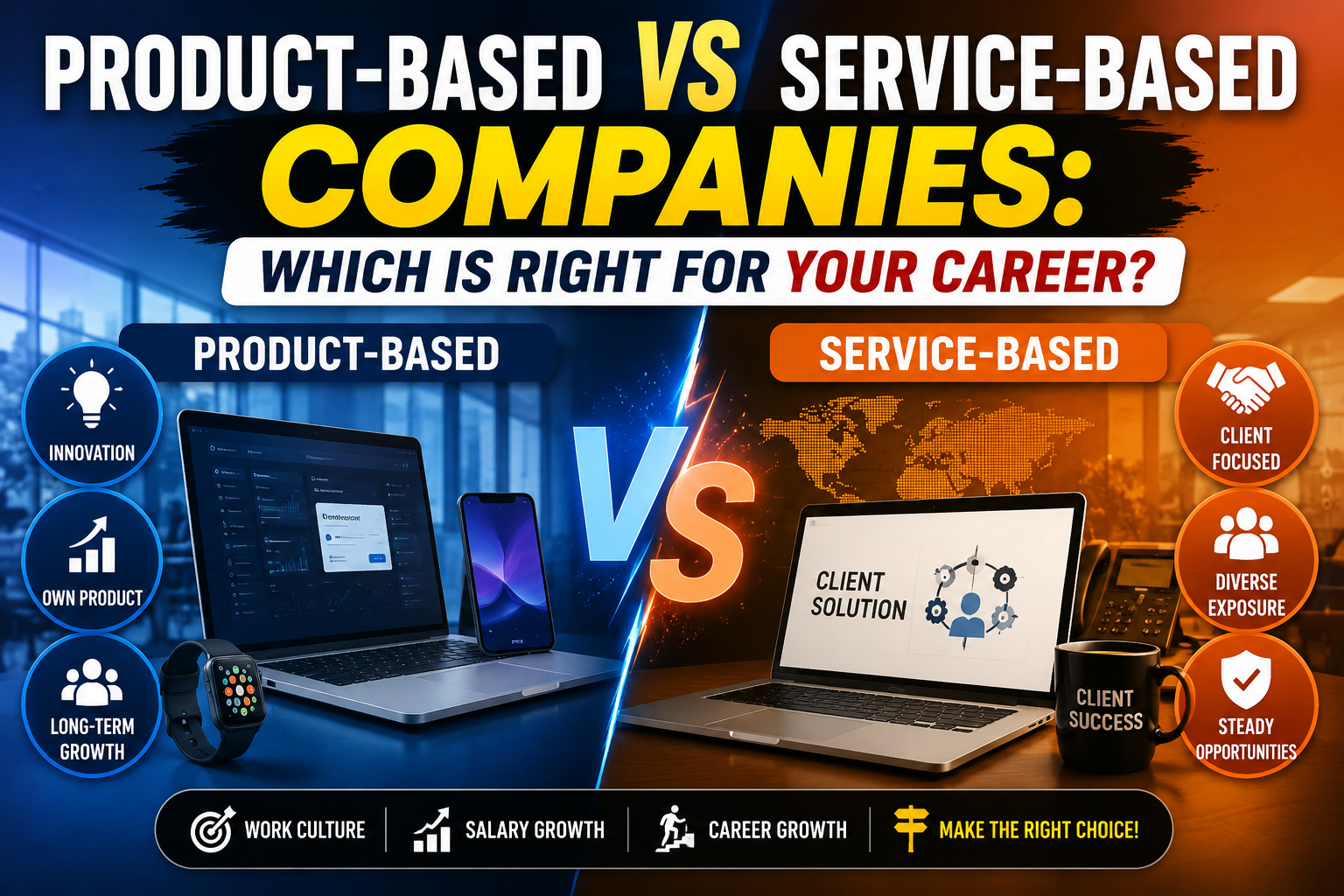
A product-based company creates a tangible or digital asset—like a software application, an operating system, or a cloud platform—and sells that exact asset to multiple customers. Think of companies like Microsoft, Adobe, Google, or local SaaS startups. They invest heavily upfront to build a piece of software, and their profitability comes from scaling it to millions of users without significantly increasing their production costs.
A service-based company, on the other hand, does not sell a pre-made software tool. Instead, they sell expertise, time, and development resources to other businesses. Organizations like TCS, Infosys, Accenture, and Wipro operate on this model. When a massive retail chain needs an internal inventory management system built or updated, they hire a service company to deploy a team of developers to build it for them. The service company bills the client based on the number of hours worked or milestones reached.
[Product-Based Model] ---> Builds One System ---> Sells to Millions of Customers
[Service-Based Model] ---> Deploys Experts   ---> Builds Customized Tools per Client
Why Do People Choose One Over the Other?
The motivation behind joining either type of organization usually boils down to your personal career goals, risk tolerance, and preferred working style.
Professionals flock to product companies primarily because of the deep engineering culture. When your company’s entire valuation relies on how well a piece of software performs, code quality, architecture, and system scalability become top priorities. Employees often get the satisfaction of seeing features they wrote used by real people globally, alongside highly competitive compensation packages and stock options.
Conversely, developers often intentionally choose service-based companies to break out of single-tech silos. A developer inside a consulting firm might spend six months working on a migration project for a healthcare provider, and then transition to building a mobile app for a banking giant. This structural rotation allows you to gather massive domain knowledge across different industries in a relatively short window of time.
Key Features of Both Models
To evaluate these paths accurately, let’s break down their defining characteristics across day-to-day operations.
Product-Based Companies
- Asset Ownership: The intellectual property stays within the company. Engineers continuously refine, optimize, and scale the exact same system.
- High Quality Bar: Since bad code directly hurts the user experience and increases server costs, code reviews are exceptionally rigorous.
- Long-Term Roadmap: Development schedules are driven by long-term strategic visions, market competition, and user feedback rather than rigid client contracts.
Service-Based Companies
- Client-Driven Timelines: The scope of work is rigidly defined by a Statement of Work (SOW). Deadlines are often tight because missing them involves financial penalties from the client.
- Resource Allocation: Employees are managed through a “bench” system. If you finish a project, you sit on the bench until you are interviewed and allocated to a new client account.
- Diverse Frameworks: The tech stack varies wildly from one project to another, depending entirely on what the client’s existing infrastructure requires.
Realistic Scenario: A software engineer at a product company might spend an entire week optimizing a database query to shave off 50 milliseconds of latency because that query runs billions of times a day. A developer at a service company during the same week might be migrating legacy code to a modern framework for a retail client, focusing entirely on meeting the launch deadline specified in the contract.
How it Works: The Financial Reality
Understanding how these companies generate revenue helps explain why their hiring bars, salary structures, and office environments are so completely distinct.
Product Company: High Upfront Cost ---> Scalable Revenue ---> High Profit Margins
Service Company: Linear Resource Cost ---> Hourly Billing ---> Steady, Predictable Margins
Product companies operate on high risk and high margins. They spend millions hiring top-tier talent to build something that might fail in the market. But if it succeeds, their margins skyrocket because selling the software to the 10,000th customer costs almost nothing compared to building it the first time. This gives them the cash reserves to offer premium salaries, sign-on bonuses, and equity.
Service companies operate on predictable, lower margins. Their revenue is tied directly to headcount. If a client pays $50 an hour for a developer’s time, the service company pays the developer a fraction of that and keeps the rest to cover overhead and corporate profits. To grow revenue, they must hire more people. Because profit margins are tied directly to headcount costs, entry-level salaries in large service companies remain tightly controlled and standardized.
Practical Work Environments
Let’s look at how this impacts your everyday routine as an employee.
The Product Team Environment
In an in-house product team, you work closely with product managers, UI/UX researchers, and QA teams who are all employed by the same company. The communication loop is highly collaborative. You have a voice in what gets built and how it gets built. The pace can fluctuate; it may be relatively calm during exploratory phases but intense when launching major updates.
The Service Project Environment
In a service setup, you are essentially an extension of the client’s team. You might report directly to a manager located in a different country and timezone. Your daily updates are heavily scrutinized because the client wants to see tangible returns on their hourly spend. The environment teaches you exceptional communication skills, client management, and professional agility under varying management styles.
Step-by-Step Guide to Choosing the Right Alignment
If you are currently evaluating job offers or deciding which skills to build next, use this logical process to determine where you fit best.
Step 1: Assess Your Core Problem-Solving Style
Do you like knowing a single system inside out, analyzing its performance metrics down to the metal? Or do you get bored easily and prefer shifting context every few months to solve a new, localized business problem?
- Deep dive focus: Aim for Product.
- Variety and breadth: Aim for Service.
Step 2: Evaluate Your Current Skill Level
Look honestly at your technical foundation. Product companies screen heavily for deep structural knowledge—Data Structures, Algorithms (DSA), System Design, and architectural patterns. Service companies place a balanced emphasis on core programming concepts, clear communications, adaptability, and your ability to learn new tools on the job.
Step 3: Align with Your Risk and Compensation Goals
Determine how much weight you place on your base package versus variable components like stock units. If you want a steady, predictable career ladder with high job security, large service enterprises offer immense stability. If you want exponential financial upside and don’t mind the faster structural pivots of tech startups or competitive pressure, target product ecosystems.
Comparative Matrix
Let’s map out the direct trade-offs you encounter when comparing these environments side-by-side.
Pros and Cons Analysis
| Company Type | Key Advantages (Pros) | Main Disadvantages (Cons) |
| Product-Based | • Higher baseline compensation & equity. • Focus on modern, clean coding practices. • Deeper sense of ownership over your work. | • High interview barriers to entry. • Risk of tech stagnation if the product ages. • Higher pressure to perform during cycles. |
| Service-Based | • Tremendous job security. • Rapid exposure to diverse business domains. • Clearer, standardized promotion ladders. | • Lower starting pay scales for freshers. • Bureaucracy can slow down internal movements. • Less control over choice of project or tech stack. |
Deep-Dive Structural Comparison
| Parameter | Product-Based Entity | Service-Based Entity |
| Primary Metric | Product adoption & system uptime | Billable resource utilization rate |
| Tech Stack Choice | Strictly governed by system architecture | Dictated entirely by client preference |
| Interview Focus | Advanced DSA, System Design, Architecture | Core Aptitude, OOPs concepts, Languages |
| Work Variety | Continuous iteration on one ecosystem | Shifting projects across multiple verticals |
Common Mistakes Professionals Make
Navigating this terrain requires avoiding a few classic career missteps that catch developers off-guard.
- Assuming Service Experience Doesn’t Count: Many engineers think that starting their career at a service company prevents them from ever transitioning to a top product company. This is false. Many developers leverage the vast domain expertise gained at service firms to clear design rounds at product companies later.
- Chasing Product Logos Blindly: Joining a failing product company with an outdated tech stack just for the “product-based” title can harm your skill growth. A highly dynamic, cutting-edge engineering project inside a service innovation lab is often far better for your portfolio than maintaining a dying legacy system at a product firm.
- Neglecting Communication Skills: Technical geniuses often fail in service companies because they struggle to articulate their progress to clients. Conversely, they can fail in product companies if they cannot collaborate effectively with cross-functional product managers.
Frequently Asked Questions
1. Can I switch from a service-based company to a product-based company later in my career?
Yes. It requires focused preparation on core computer science fundamentals, data structures, and system design patterns. Thousands of engineers successfully make this jump every year.
2. Why do service-based companies pay less to entry-level freshers?
Their revenue scales linearly with headcount based on fixed billing rates from clients. Because profit margins per employee are bounded, they rely on standardized, bulk compensation models for entry-level talent.
3. Are job security levels higher in product or service companies?
Large service-based organizations generally offer higher job stability due to diversified client portfolios. Product companies, especially early-stage startups, carry higher structural risk if their product loses market share or fails to secure funding.
4. What is the “bench period” in a service company?
The bench period is the time an employee spends unallocated to any active, revenue-generating client project. During this window, you remain on the payroll and typically use the time for upskilling, certifications, or internal training.
5. Do product companies care more about university degrees or practical skills?
While top tier product firms historically favored elite colleges, the industry has shifted significantly. Proven open-source contributions, a strong GitHub portfolio, and passing technical coding assessments matter far more than your university degree.
6. Do service companies work on modern technologies like Cloud Architecture or AI?
Yes. Most large global enterprises outsource their digital transformation journeys to service firms. You can work on highly sophisticated cloud native apps or enterprise AI deployments if you land on the right client account.
7. Is the work-life balance better in product environments?
It varies by company culture. Product companies often feature flexible hours and fewer timezone conflicts, but they can experience high-stress crunch periods before major updates. Service environments can have tight daily deadlines driven by rigid client contracts.
8. What kind of companies are considered hybrid?
Some organizations build and sell proprietary software platforms but also deploy internal engineering consulting teams to help large clients customize and install those platforms. These offer a blended work experience.
9. How long should I stay at a service company before attempting a switch?
There is no fixed rule, but 2 to 4 years is a common sweet spot. This gives you enough time to experience a couple of full project life cycles and build corporate communication skills while preparing for technical product interviews.
10. Which path is better for launching my own tech startup eventually?
Both offer unique lessons. Product companies teach you how to design scalable code architectures and prioritize feature backlogs. Service companies give you a front-row seat to B2B sales, client negotiation, resource management, and understanding how real-world businesses buy software.
Final Thoughts
The decision between a product-based vs service-based company shouldn’t be about chasing prestige; it’s about choosing the type of problems you want to solve every morning.
If you love deep-diving into code architecture, optimizing microservices, and want to own the evolution of a single piece of software over multiple years, target a product-based company. The intense interviewing process is well worth the long-term payoff.
However, if you are looking to get your foot in the door of the tech industry, want to explore multiple business sectors rapidly, or enjoy the dynamic nature of consulting and client management, a service-based company provides an exceptional launchpad. Your focus should always be on the quality of engineering happening within your specific team, rather than just the business model of the corporation printed on your paycheck.